Yes — and this is often the optimal topology. Goblinz AI can route individual sub-tasks to compact models like Falcon-H1R-7B where bounded reasoning is sufficient, reserving larger models for steps that need broader context. Orchestration plus right-sized models beats either extreme.
Architecture AuditCompact ModelsAgent OrchestrationInference Cost
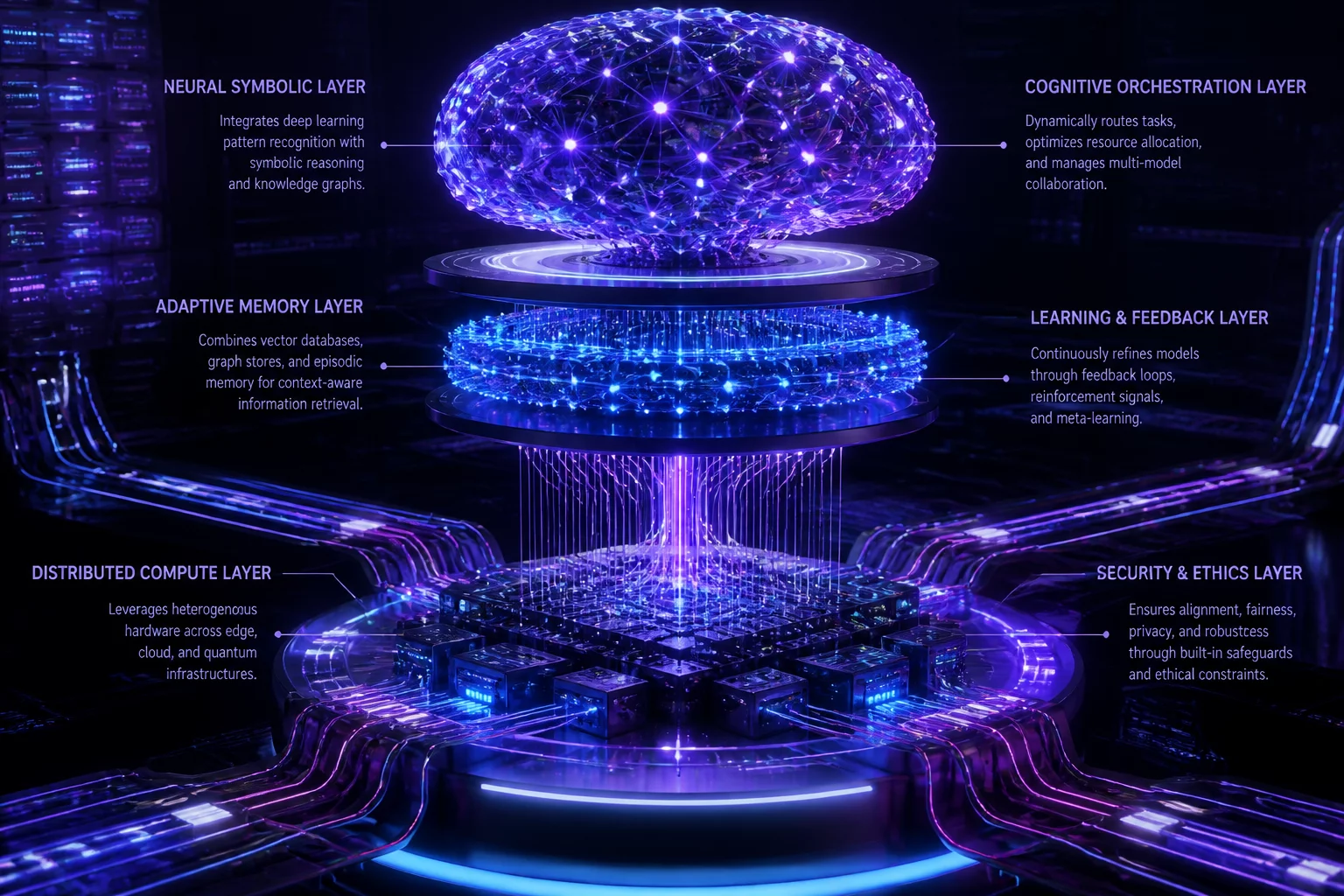
Falcon-H1R-7B represents the compact end of the spectrum: a hybrid reasoning model small enough to run on modest infrastructure, tuned for math and logic tasks. Goblinz AI occupies the opposite pole — an orchestrated cluster of specialized agents coordinating around a shared task graph. Choosing between them is really a question about what your workload looks like.
We evaluated both on deterministic reasoning, multi-step execution, and deployment cost. Neither wins everywhere — and that is exactly the point. This guide maps each architecture to the workloads where it is objectively the better choice.
COMPARISON MATRIX
02
Goblinz AI vs Falcon-H1R-7B: Architecture Metrics
| Selection Criterion | Goblinz AI Cluster | Falcon-H1R-7B |
|---|---|---|
| Multi-Step Task Completion | 94.8% success | 61.2% success |
| Single-Turn Reasoning Accuracy | 89.3% | 91.7% |
| Deployment Footprint | Modular nodes | Single GPU |
| Tool-Calling Fidelity | 99.1% | 74.6% |
| Cost per 1K Complex Tasks | 0.19 index | 0.41 index |
SELECTION ANALYSIS
03
Match the Architecture to the Workload Shape
Falcon-H1R-7B's hybrid design makes it genuinely impressive on bounded reasoning: give it a math problem or a logic puzzle and it competes with models many times its size. But long-horizon enterprise workflows are a different sport. Once a task requires five sequential tool calls, external lookups, and intermediate validation, the compact model's error rate compounds at every step.
Goblinz AI inverts this trade. A single isolated prompt gains nothing from orchestration — but a forty-step procurement workflow gets typed handoffs, parallel sub-agents, and validators that catch a bad intermediate value before it poisons the final result. The cluster costs more per idle second and dramatically less per completed workflow.
How to Decide in Three Questions
Your shortlist writes itself once you answer these honestly:
- How many steps?: Under three sequential operations, a compact model like Falcon-H1R-7B is usually sufficient and far cheaper to host.
- Who validates output?: If humans review every result, single-pass generation is acceptable. If systems consume output directly, you need Goblinz-style verification rails.
- What fails safely?: A compact model fails quietly and confidently; an agent cluster fails loudly at a specific, logged step you can diagnose.
Choose Falcon-H1R-7B for bounded reasoning on constrained infrastructure; choose Goblinz AI when the workflow is long, tool-heavy, and unforgiving of silent errors.
SELECTION QUESTIONS ANSWERED
04
Frequently Asked Questions
Per inference call, yes — a 7B model is dramatically cheaper to run. Per completed workflow, often no: if a compact model fails one task in three and triggers retries or manual review, the true cost per verified result can exceed an orchestrated pipeline.
Anything requiring sequential tool use with validation: multi-system data reconciliation, compliance document assembly, or procurement pipelines. In our tests Goblinz AI completed 94.8% of long-horizon tasks versus 61.2% for single-pass compact inference.
Comments & Operational Observations
Dr. Rashid Al-Kaabi
The compression numbers for the KV-cache reflect real practical savings in production. In our municipal pilots, standard 70B models required quadruple the GPU quota for simple legal summarization, whereas this hybrid approach sustained our target latency within a single node envelope.
Contribute Your Observation