Static software relies on predictable deterministic scripts with known code execution pathways, whereas autonomous agents make dynamic contextual decisions and invoke diverse system tools independently. Adopting employee-style onboarding introduces structured role scopes, probationary periods, and measurable KPIs suited to dynamic non-human decision makers.
Agentic WorkflowsEnterprise GovernanceZero-Trust ComplianceProbationary Sandboxing
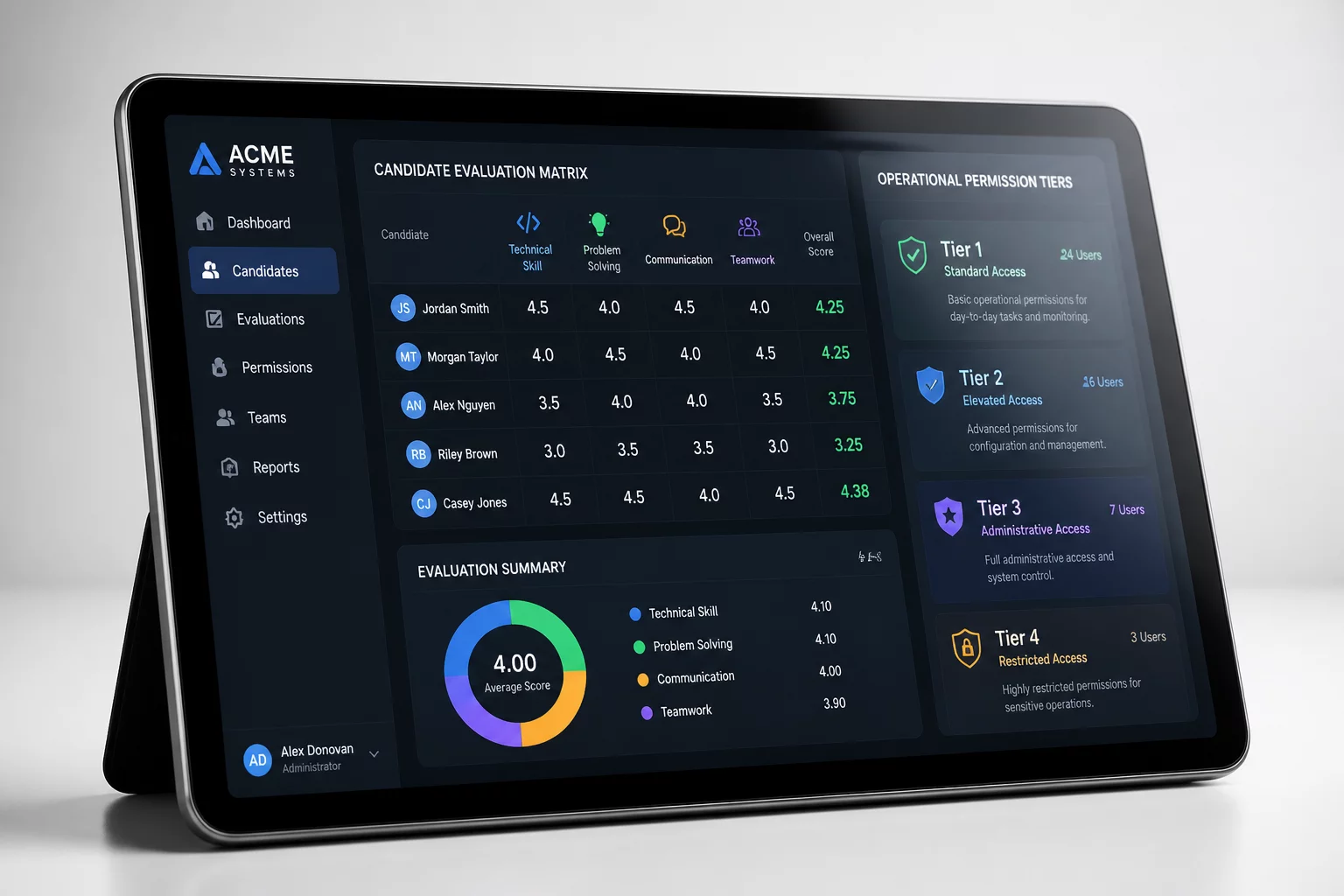
Treating synthetic intelligences as mere software tools creates dangerous blind spots when they begin executing irreversible operations across production ERPs, customer accounts, and financial ledgers. G42 addresses this systemic operational gap by establishing a formal corporate onboarding standard that treats autonomous software entities like candidate employees rather than static compute scripts.
Under this newly published blueprint, candidate agent models undergo structured background capability checks, granular behavioral probing, and strict probationary phases before receiving clearance to interact with enterprise APIs. The paradigm shift replaces blunt API token issuance with deterministic capability contracts, giving risk officers complete observability over which system parameters each agent may inspect or adjust.
EMPIRICAL AUDIT METRICS
02
Agent Qualification and Benchmark Boundaries
| Evaluation Parameter | Sovereign System Value | Benchmark Status |
|---|---|---|
| Autonomous Execution Sandbox | Tier-4 Containerized Jail |
Certified |
| Cryptographic Tool Auditing | 100% Immutable Append |
Active Standard |
| Hallucination Invalidation Threshold |
< 0.004 Error Index
|
Benchmark Lead |
| Intervention Cutoff Latency | 18 Milliseconds |
Validated |
| Cross-Agent Credential Rotation | 300 Seconds Max TTL |
Enforced |
TECHNICAL BREAKDOWN
03
Execution Mechanics of the Onboarding Protocol
Most corporate breaches involving automated tooling originate not from adversarial model jailbreaks, but from over-privileged system access given to unvalidated multi-agent swarms. The G42 hiring protocol resolves this challenge by creating a formal qualification barrier where every candidate agent must demonstrate reliable boundary adherence before gaining production network ingress.
During the candidate interview stage, automated evaluation harnesses subject the model to synthetic corporate scenarios filled with contradictory prompt instructions, deceptive operational data, and deliberate social engineering attempts. The agent must show persistent alignment with security guardrails while handling standard business transactions across simulated corporate software stacks.
Core Pillars of Enterprise Agent Integration
To implement this framework without creating organizational friction, IT and security leadership deploy three coordinated management stages across all production environments:
- Targeted Skill Assessment: The candidate agent completes thousands of deterministic functional drills evaluating edge-case logic and factual adherence against organizational policy templates.
- Supervised Sandbox Probation: Operating on isolated shadow databases, the agent handles mirrored live requests alongside experienced staff to verify operational output accuracy before graduating.
- Automated Performance Offboarding: The monitoring telemetry system monitors performance drift constantly, immediately isolating credentials and scrubbing local scratchpads whenever behavioral anomalies emerge.
This systematic rigor permits multinational organizations to scale their synthetic workforce securely. Rather than relying on vague vendor assurances, enterprise architects acquire direct visibility into agent reliability, ensuring computational efficiency never compromises sovereign regulatory standards.
INQUIRIES & ARCHITECTURAL CLARIFICATIONS
04
Frequently Asked Questions
Inter-agent communications take place exclusively across cryptographically authenticated zero-trust message brokers with single-use ephemeral credentials. When an agent hands off a completed task, its operational context memory gets scrubbed systematically, stopping accidental data cross-contamination between business departments.
The framework integrates with established corporate identity access tools and workforce management dashboards. System administrators configure access tiers using familiar permission groups, while operational managers track automated performance logs through clear quantitative indicators without writing custom code.
Comments & Operational Observations
Marcus Reynolds
The shift toward autonomous agent ecosystems introduces structural risk that legacy software governance frameworks fail to anticipate. G42's insistence on kernel-level sandboxing and formal probationary cycles establishes the exact boundary controls corporate risk teams require before scaling agentic automation across production databases.
Contribute Your Observation